
We look forward to seeing you on Thursday, September 10, 2026, at 10:00 AM in the Administrative Board Room (Rectorate, Panduri Road no 90) for the conference Dynamics of FtsZ clusters in the Z-ring of E. coli.
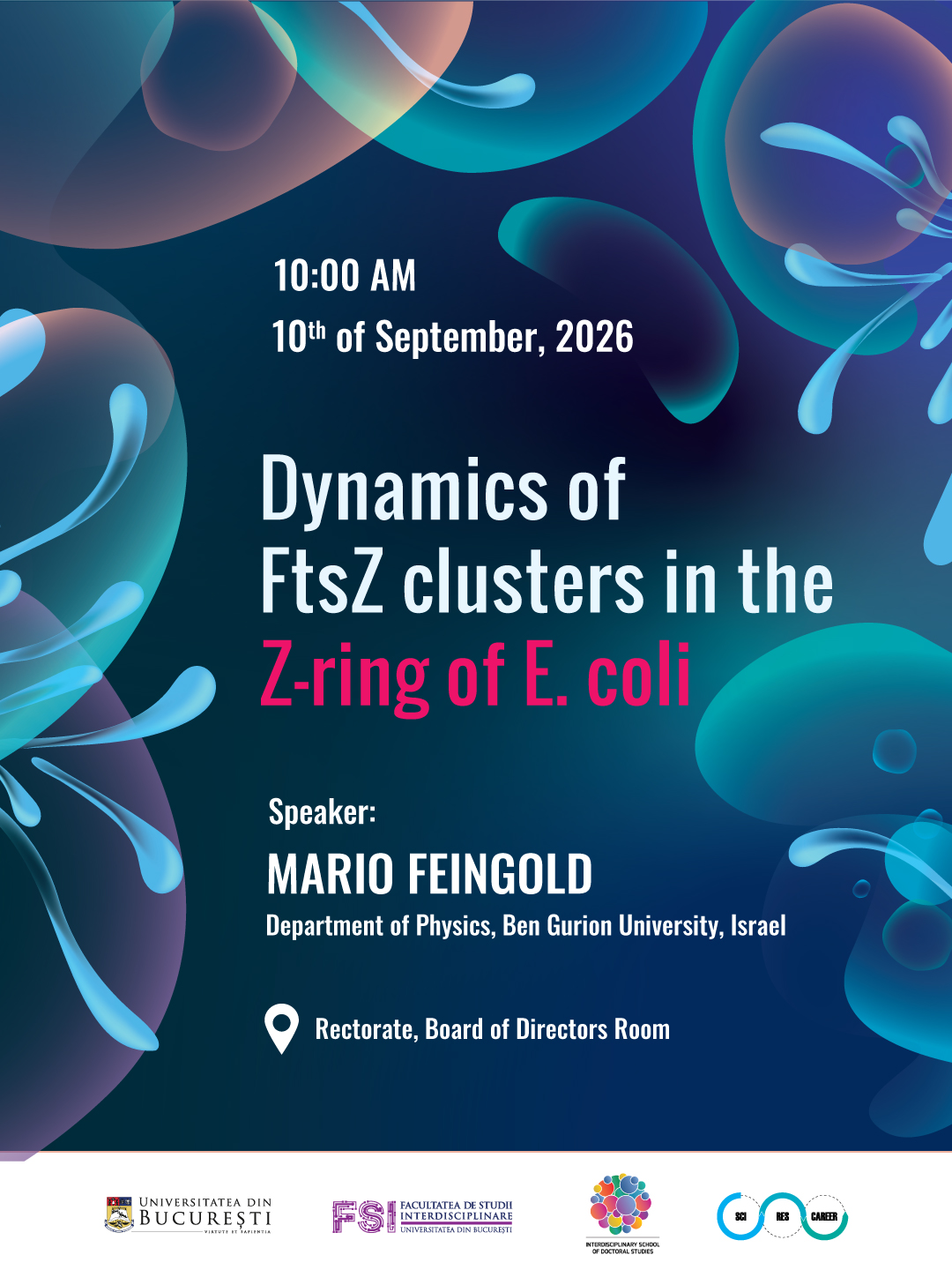
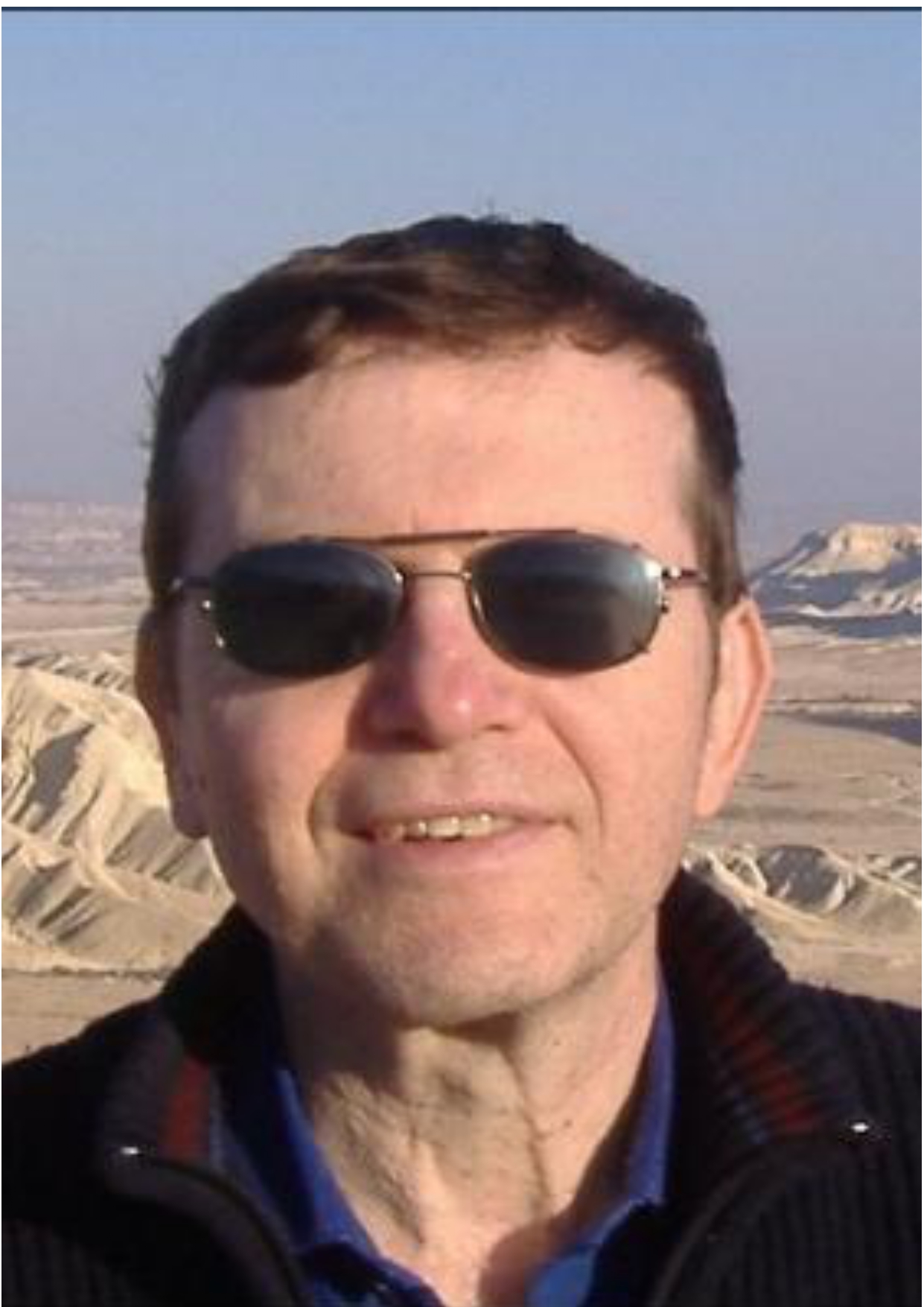
Speaker: Mario Feingold
Department of Physics, Ben Gurion University, Israel
Webpage: https://sites.physics.bgu.ac.il/mario/
Abstract: During bacterial cell division, the FtsZ protein polymerizes on the cytoplasmic face of the inner cell membrane to form a ring-like structure, the Z-ring, at mid-cell. The current perception of the Z-ring is that of a rotating structure resulting from the treadmilling of its FtsZ filaments. However, it remains an open question as to how this dynamic Z-ring is associated with septum formation and how it leads to the emergence of symmetric constriction. We address this question by tracking FtsZ clusters of live E. coli cells using image analysis.
We find that the motion of the FtsZ clusters is significantly more complex than a simple rotation including tracks that are localized, others that display rapid changes in the direction of motion and also tracks that are apparently random in nature. Using Mean-Square Displacement (MSD) analysis we find that the motion of the FtsZ clusters is mainly diffusive rather than directed. Specifically, trajectories are well approximated by a piecewise linear function, and the extent of the linear sections grows with temperature. We expect that in the limit where the FtsZ protein is uniformly distributed along the Z-ring the motion will become purely rotational.
Mario Feingold completed his PhD in Physics at Technion in 1986. Between 1986 and 1991, he was a Weizmann postdoctoral fellow at the University of Chicago (in the group of L.P. Kadanoff), at the Lawrence Berkely Labs and the Cavendish Labs at Cambridge University. Since 1991, he has been on the faculty of Ben Gurion University’s Department of Physics. His interests center on the study of bacterial division using a combination of various microscopy approaches (including Optical Tweezers) with quantitative image analysis to understand the structure and dynamics of the Z-ring, mechanisms leading to variability in bacterial populations and the dynamics of nucleoid segregation in bacterial cells.